
The answer so far
GHK-Cu is used in some topical cosmetic claims and is also sold as an injectable wellness peptide. Those are different interventions; do not transfer evidence or safety assumptions from one to the other.
GHK-Cu is the copper-bound form of GHK, a tripeptide isolated from human plasma. It is used in some topical cosmetic formulations. Injectable GHK-Cu products marketed for regeneration or anti-ageing raise different evidence and regulatory questions. FDA notes that compounded injectable drugs containing GHK-Cu may pose an immune-reaction risk related to aggregation and peptide impurities, and that human safety data are limited.235
On this page
- Where this ingredient appears
- Topical and injectable claims are not interchangeable
- What a small post-laser study found
- A small eyebrow study, examined more closely
- What about the scalp-hair study sometimes cited online?
- What the regulator identifies
- Separate the marketing bundle
- What FDA plans to review in 2027
- Sources
Before you read the detail
What it is
The copper-bound form of GHK, used in some topical cosmetics; injectable products raise separate quality and regulatory questions.1
What human evidence shows
Small topical studies have limited or mixed findings and do not establish benefits from injections or ordinary skin and scalp use.67
Main cautions
FDA notes limited human safety data and possible immune reactions from aggregation or peptide impurities in compounded injectable GHK-Cu.1
Current status
Topical evidence does not establish that an injectable product is sterile, effective or authorised.3
Where this ingredient appears
GHK-Cu appears in several product conversations, but the product and route determine which evidence applies. For a direct comparison with GLOW and KLOW, see the side-by-side explanation, or read what changes between topical and injectable GHK-Cu. For an everyday skin-care question, see what to expect from a copper-peptide serum.
To follow the collagen claim from cells and animal studies to human skin research, read GHK-Cu and collagen explained. For the proposed role of each ingredient and the evidence behind it, see how GLOW and KLOW are meant to work. Glutathione is a different peptide also sold in skin products; the glutathione comparison explains its distinct evidence and routes.6
Illustrations
Mechanisms and repair claims are hypotheses or early research, not established clinical benefits. Ingredients and products vary.
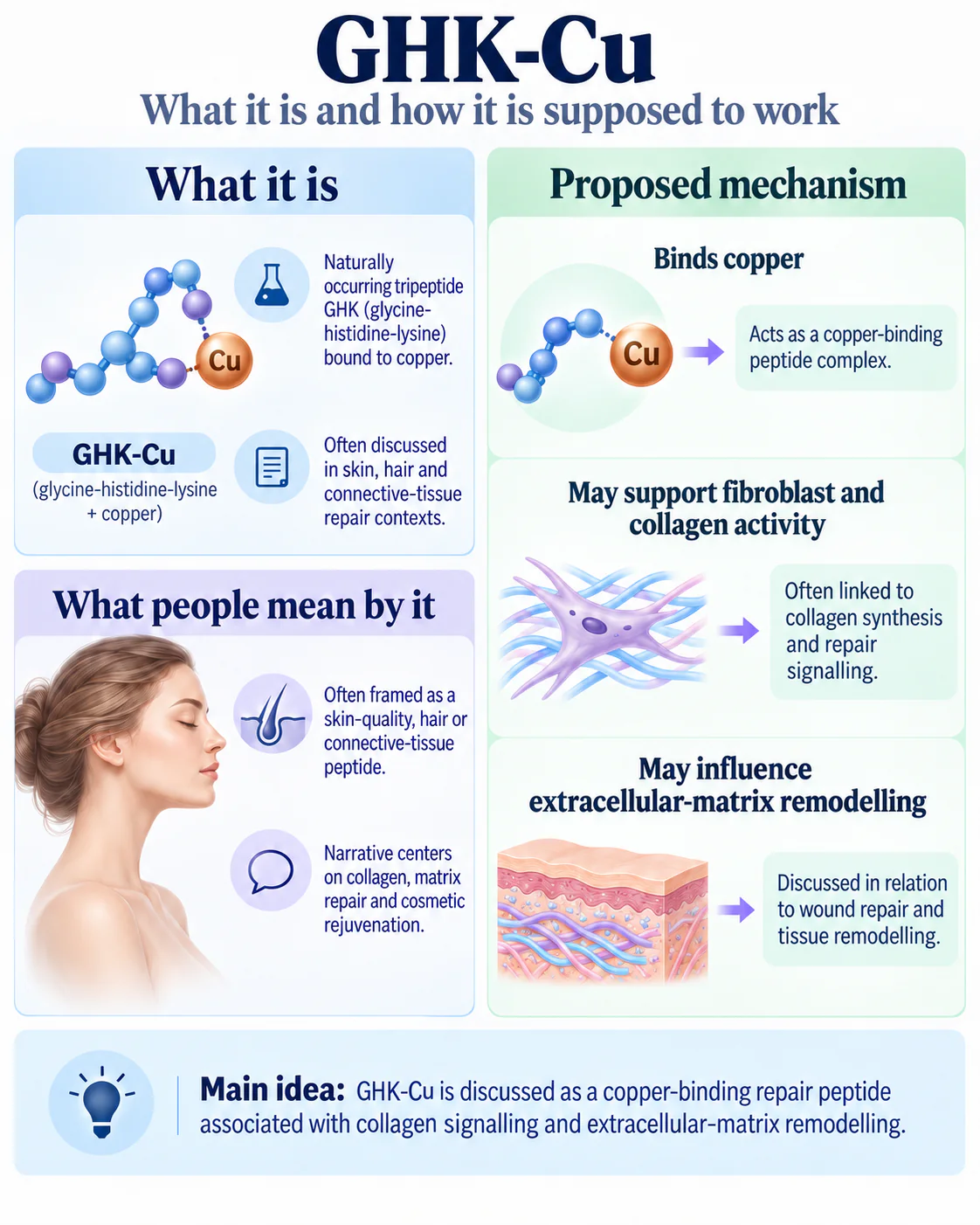 Open image at full size
Topical and injectable claims are not interchangeable
A topical cosmetic ingredient and an injected product differ in formulation, exposure, manufacturing and safety questions. Evidence for a cream cannot establish that an injectable product is sterile, reaches a target tissue or improves healing in people. See storage claims, product quality and travel for practical context. Understand copper peptides with retinol, vitamin C and exfoliating acids.35
When comparing products, check the exact ingredient, the full formulation, intended route and any batch information. A named ingredient or a percentage on a label does not by itself establish that the finished product has the same evidence or quality as one used in a study.35
A cosmetic can irritate skin or cause an allergic reaction, and other ingredients in the formula may be responsible. If a product irritates your skin, stop using it and ask a pharmacist or clinician for advice. Sudden swelling of the lips, mouth, tongue or throat, or difficulty breathing, needs emergency help immediately. See skin irritation and allergic reactions.1211
What a small post-laser study found
A 2006 randomized study compared skin-care regimens with and without topical GHK-Cu after carbon-dioxide laser resurfacing around the mouth. Thirteen people completed the study. After 12 weeks, blinded and computer assessments found no statistically significant difference between groups in redness resolution, wrinkles or overall skin quality, while participants using the GHK-Cu regimen reported greater improvement in skin quality. This small post-procedure study cannot rule out a benefit or establish an effect on ordinary skin.6
A small eyebrow study, examined more closely
In a 2026 randomized, blinded study, 18 healthy adults aged 18–40 with sparse eyebrows used a GHK-Cu serum on one eyebrow and a matching serum without it on the other for 12 weeks. Researchers photographed a one-square-centimetre area of each eyebrow: at week 12, the average count was 30.50 hairs on treated sides and 28.67 on comparison sides. The difference between these counts is not a count of new hairs or a baseline-adjusted treatment effect. The authors also reported a difference in hair diameter and higher participant satisfaction. Whether the small measured difference produces a noticeable benefit for other people is uncertain. The protocol excluded adverse patch-test reactions, although the authors also stated that no allergic reactions were observed during patch testing; and no adverse events were reported during follow-up; this small, short study cannot rule out uncommon reactions or establish long-term safety. The authors declared no conflicts of interest; the report does not state a funding source. It does not establish scalp-hair growth or benefits from injections. For the numbers and the scalp comparison, read GHK-Cu and hair growth.7
What about the scalp-hair study sometimes cited online?
A 2016 study in 45 men with male-pattern hair loss compared two strengths of a topical complex of GHK and another substance, 5-aminolevulinic acid, with placebo over six months. The researchers reported a greater change in a hair-count ratio for one concentration versus placebo, but no statistically significant difference among groups in hair length or thickness. The small study cannot establish long-term benefit or safety.8
The tested combination was not GHK-Cu alone, so it cannot isolate the effect of GHK, establish that an individual copper-peptide serum works on scalp hair, or justify extrapolation to injections. The study report reviewed here does not clearly describe how participants were assigned to groups; the paper acknowledged support from the Small and Medium Business Administration of Gwangju & Jeollanam-do and thanked an individual at Unique Medicare Co.; that acknowledgment alone does not establish the company’s role. Hair loss has several possible causes: see also what biotin evidence can and cannot tell us.8
What the regulator identifies
FDA says compounded injectable drugs containing GHK-Cu may pose a risk of an immune response because of possible aggregation and peptide-related impurities; human data to assess safety are limited. These concerns are reasons for caution, not proof that every product causes harm.34
In the United States, compounded drugs are not FDA-approved: FDA does not review their safety, effectiveness or quality before marketing. This describes compounded drugs, not the regulatory status of every cosmetic or products in other countries.34
If you have already injected a product and the skin is painful, hot and swollen, seek urgent medical advice; these signs can have different causes, including infection. Sudden swelling of the lips, mouth, tongue or throat, or difficulty breathing, needs emergency help immediately. Tell the clinician what you used and, if available, bring its packaging. See injection-site reactions and when to seek help.1011
Separate the marketing bundle
GHK-Cu is often sold in stacks with TB-500, BPC-157 or growth-hormone peptides. Combining substances makes attribution, interaction assessment and adverse-event reporting harder. Read each molecule, route and product separately. Explore the TB-500 profile, the BPC-157 profile, how research moves from laboratory models to people.
What FDA plans to review in 2027
FDA says it plans to convene its Pharmacy Compounding Advisory Committee before the end of February 2027 to discuss GHK-Cu, cathelicidin LL-37, dihexa acetate, melanotan II and pegylated mechano growth factor for possible inclusion on the section 503A bulk substances list. As checked on 5 November 2026, FDA says the meeting time and location are to be scheduled. The committee gives non-binding advice: discussion does not mean inclusion, FDA approval, proven benefit, or that the HHS interim policy will be extended to these substances. Compare that planned discussion with the separate 2026 HHS policy.
In its May 2026 nomination record, FDA lists GHK-Cu except injectable routes as under evaluation and records that the injectable nomination was withdrawn. FDA separately identifies injectable GHK-Cu as raising safety concerns. This distinction does not establish the safety or approval of any product.319
Development & regulatory context
These selected records are not a complete global legal-status list. Approval depends on the product, use, population and country; check each record’s date.
Injectable products marketed as GHK-Cu
Unapproved injectable products; safety information limited
Cosmetic and wellness claims
FDA notes potential immunogenicity from aggregation and peptide-related impurities and limited human data for injectable routes. TGA warns about unapproved peptide products.3
Further reading
Trusted external resources selected to help explain this page. They open in a new tab.
- FDA compounding safety assessment ↗
- Effects of Topical Copper Tripeptide Complex on CO2 Laser–Resurfaced Skin ↗Small randomized comparison after laser resurfacing; abstract accessed, not general cosmetic or injection evidence.
- The Efficacy of 2% Copper Peptide (GHK-Cu) Serum for Eyebrow Hypotrichosis ↗Full report of a small 12-week eyebrow study: patch-test reactors were excluded, long-term safety was not measured, and funding was not stated.
Sources, kept close.
Selected supporting sources; this is not a complete literature review.
- Bulk drug substances nominated for use in compounding under section 503AU.S. Food and Drug Administration · Official FDA nomination record; United States
- Effect of transition metals on recovery from plasma of the growth-modulating tripeptide glycylhistidyllysineJournal of Chromatography / PubMed · Original plasma isolation and laboratory study, 1979
- Certain bulk drug substances for compounding that may present significant safety risksU.S. Food and Drug Administration · Regulator safety assessment
- Compounding and the FDA: Questions and AnswersU.S. Food and Drug Administration · Regulator compounding information
- Concerns regarding the public health risks associated with unapproved peptide productsTherapeutic Goods Administration · Regulator safety communication
- Effects of Topical Copper Tripeptide Complex on CO2 Laser–Resurfaced SkinArchives of Facial Plastic Surgery · Randomized human study
- The Efficacy of 2% Copper Peptide (GHK-Cu) Serum for Eyebrow HypotrichosisProcedia of Multidisciplinary Research · Randomized split-face human study
- Efficacy of a Complex of 5-Aminolevulinic Acid and Glycyl-Histidyl-Lysine Peptide on Hair GrowthAnnals of Dermatology / PubMed Central · Small controlled human study, 2016
- Meeting of the Pharmacy Compounding Advisory Committee before the end of February 2027U.S. Food and Drug Administration · Official advisory committee meeting notice; United States
- CellulitisNHS · Official clinical guidance
- AnaphylaxisNHS · Official clinical guidance
- Contact dermatitisNHS · Official clinical guidance