
Nutrition guide
Protein drinks.
What a protein shake can add to a diet, what labels leave out, and why convenience is not the same as a proven performance benefit.
3 min read
A plain-language guide to protein foods, fortified products, vitamins and the evidence behind supplement claims.
Readability reviewed 6 Nov 2026
Prepared is when this page was drafted. A readability review checks clarity. Dates alongside individual sources record when those sources were accessed or checked. Read our editorial standards →
Protein drinks, bars and vitamin products are familiar, but they answer different questions. This hub explains what the products contain, what evidence can show and where marketing claims outrun the data.
Nutrition products sit on a spectrum: ordinary foods, fortified foods, powders and dietary supplements are not interchangeable. A protein drink can be convenient food; a vitamin tablet can correct a deficiency; neither category automatically improves health in someone who already has enough of a nutrient. Labels, dose, total diet, medicines and the quality of evidence all matter.136
A protein bar sold as food, a powdered drink, a multivitamin and an herbal capsule may sit beside one another online but are regulated and studied differently. Ask what the product contains, whether it is a conventional food or supplement, what claim is being made and which evidence could test that claim. A nutrient label is not a clinical trial. For practical questions, explore storing supplements and foods and travelling with them. For another common supplement question, explore CoQ10 and statin muscle pain. Explore NAC medicines and supplement claims. For an herbal example, explore turmeric and curcumin. For a mushroom supplement often marketed for focus, see lion’s mane and cognition. For sleep and mood claims, see 5-HTP evidence and interactions.34
Protein supplies amino acids used to build and repair body structures and make proteins. Many people can meet their needs from ordinary foods; powders and bars may be convenient when eating is difficult or schedules are unusual. More protein does not automatically create muscle or improve performance: training, total energy, health and the person’s starting diet affect outcomes. Products can also add sugars, saturated fat, caffeine or large calories.12
Vitamins and minerals are essential in small amounts, but the dose–response curve is not ‘more is better’. A supplement can be useful when intake or absorption is inadequate, during some life stages, or when a clinician identifies a deficiency. Multivitamins have varied formulas and have not reliably prevented cardiovascular disease or death in broad populations. Some nutrients interact with medicines or accumulate at high doses. Explore essential nutrients beyond vitamins and minerals, or read about folate and vitamin B12. For minerals, explore iron, zinc, iodine, selenium and copper.653
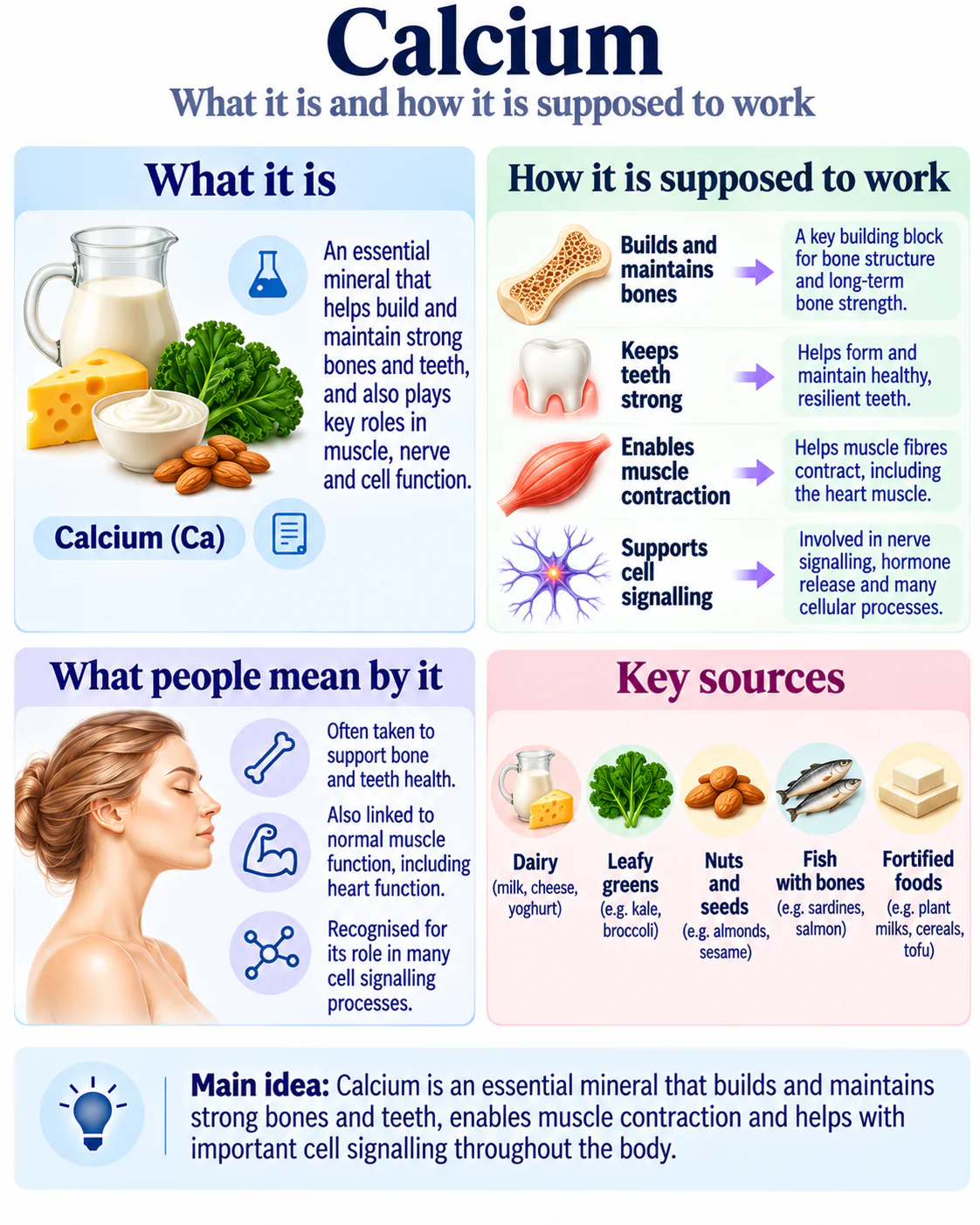
Calcium is an essential mineral that helps build bones and teeth and contributes to muscle contraction, nerve signalling and hormone release. Sources include dairy foods, kale and broccoli, nuts and seeds, fish eaten with bones, and calcium-fortified foods. Amounts and absorption vary by food.
Separate ‘contains protein’ from ‘builds muscle’, ‘supports immunity’ from ‘prevents infection’, and a biochemical pathway from a patient-important outcome. Look for the population, comparator, duration, measured outcome, missing data and harms. Products marketed through testimonials or a proprietary blend may provide less usable evidence than a clearly labelled food or a well-designed trial. For an example, explore NMN, NAD and healthy-ageing claims. For weight and blood-sugar claims, see berberine and the evidence.45
Treat the label as a starting record, not proof. Check serving size and total intake, compare the ingredient list with other products, and remember that supplements can interact with medicines, affect laboratory tests and matter around surgery. This site does not recommend a product or dose and cannot replace advice about a diagnosed deficiency or medical condition. Compare protein products and learn about supplement labels, interactions and storage. Cannabinoids have their own separate collection.45
What a protein shake can add to a diet, what labels leave out, and why convenience is not the same as a proven performance benefit.
How to read a protein bar label, compare it with ordinary food, and separate convenience from claims about performance or health.
How vitamins work, when supplements can help, and why a broad multivitamin is not a universal health intervention.
What creatine does in muscle, where performance evidence is strongest, and why a familiar supplement is not a universal health treatment.
What vitamin D does for bone health, what supplementation trials do not show, and why more is not automatically better.
A mineral involved in hundreds of body processes, with supplement claims that need to be separated from deficiency treatment and medication use.
How ALA, EPA and DHA differ, what fish and algal oils contain, and why supplement marketing should not be confused with cardiovascular evidence.
What hydrolysed collagen products contain, where small trials suggest possible effects, and why “beauty” or joint claims remain product- and outcome-specific.
What vitamin B9 does, how folate and folic acid differ, and why timing matters in pregnancy.
Why B12 matters for nerves and blood cells, where it comes from, and why absorption matters.
What this B vitamin does, where it is found and how to interpret supplement claims.
What this B vitamin does, where it is found and how to interpret supplement claims.
What this B vitamin does, where it is found and how to interpret supplement claims.
What this B vitamin does, where it is found and how to interpret supplement claims.
How to understand B6 in foods and supplements, what mood research actually found, and why labels can add up.
What this B vitamin does, where it is found and how to interpret supplement claims.
Why iron matters, what a low result can mean and how to weigh supplements and their risks.
What this mineral does, food sources and how to interpret supplement claims.
What this mineral does, food sources and how to interpret supplement claims.
What this mineral does, food sources and how to interpret supplement claims.
What this mineral does, food sources and how to interpret supplement claims.
An essential nutrient for cell membranes, signalling and metabolism—and how to understand supplement claims.
How different fibres support digestion and why food fibre and fibre products are not interchangeable.
Why strain, product and outcome matter when interpreting probiotics research.
A closer look at NAD, a small human trial and the gap between a blood marker and a longer life.
What trials found, why products differ and which medicine interactions matter.
How the body clock, jet lag, insomnia and product safety are different questions.
What vitamin E does, why food and high-dose supplements are different, and what the SELECT trial found.
Food, deficiency and the difference between preventing a cold and shortening its symptoms.
Explore the forms in food and supplements, what research shows, and the questions that matter in everyday use.
What short trials suggest, why extracts differ and what is known about interactions and liver injury.
What human studies show, what remains uncertain and why berberine is not interchangeable with a prescribed medicine.
What studies show about migraine, statin-related muscle pain and heart health, and which interactions need attention.
Why overdose treatment, mucus-thinning medicines and supplement claims are separate questions.
What branched-chain amino acids do, how they compare with protein foods, and what muscle studies actually measured.
What a gut-derived compound does in research, what human trials have measured and where the claims go further.
What a knee-pain trial found, why formulations differ and what regulators say about liver injury.
What knee-pain trials found, why guidelines differ and the interaction with warfarin.
What small human trials of Hericium erinaceus found, and where brain-health claims go beyond the evidence.
What small studies suggest, why serotonin is not a simple answer, and which interactions matter.
A closer look at the molecule your cells make, the supplements and drips sold in its name, and what evidence can tell us.
What protein powders can add to resistance training, what the trials actually measure, and why a supplement is not a shortcut to muscle growth.
A practical way to read serving sizes, ingredient amounts, claims and quality signals without treating a label as proof of benefit.
What the strongest creatine evidence covers, which safety questions remain personal or product-specific, and why a common supplement still needs context.
What vitamin D does in the body, where supplementation helps prevent deficiency, and why broad prevention claims need trials that match the outcome.
The answer changes when a dry powder is mixed or a sealed drink is opened.
Sunlight, bathrooms, refrigeration and expiry dates depend on the product in the bottle.
How packaging, oxidation and the product label affect storage decisions.
What dry storage, moisture and mixing mean—and what experiments cannot tell you.
A practical way to read the whole label and compare what you will actually consume.
Choline, essential fats, protein, fibre and water each have different roles—and a product is not the same thing as a nutrient.
What sodium and potassium do, where they come from, and when electrolyte products need more context.
What small cognitive studies, a pooled review and an EU scientific assessment actually found.
Sugar alcohols, added fibre and lactose are different possible explanations.
What the vitamins do, what trials measured, and why warfarin changes the question.
What an early hormone study and a later hair-measurement trial can—and cannot—tell us.
What scans in semaglutide and tirzepatide studies show, and why lean mass is not the same as muscle strength.
How to interpret laboratory results, serving sizes and uncertainty without assuming every product is the same.
Follow the different paths from animal foods and plants to the vitamin A your body uses.
Retinol, beta-carotene, RAE, IU and percentages explained with a worked label.
Why the form matters, how to read prenatal labels, and when a retinoid medicine needs urgent attention.
Why one medicine can reduce absorption while other products may increase the risk of excess.
Why one possible overdose and repeated high intake need different questions—and where to get help.
Why vitamin A matters in dim light, what else can affect sight and how deficiency is assessed.
What the two trials found, who they studied and why eye-supplement labels need a closer look.
ATBC and CARET tested supplements, not vegetables. Here is what they found and what the numbers mean.
Why children need vitamin A, why guidance differs and when a child needs medical help.
What differs between a vitamin supplement, a retinol serum and retinoid medicines—and what the studies show.
What the immune system needs, why deficiency matters and what infection studies can—and cannot—tell us.
What “fat-busting” claims can mean, what the body does naturally and which results matter.
Where abdominal fat is stored, how it is measured and what a number can—and cannot—say about health.
Practical food and fluid questions, from a smaller appetite to symptoms that need medical attention.
Why the scale can level off, what studies mean by a plateau and how to think about maintaining weight.
Follow the evidence and practical questions behind three very different ways this peptide is sold.
A plain-language guide to possible causes, clinical checks and what different tests can—and cannot—show.
Why deficiency and supplement excess can cause similar symptoms, and what to take to a healthcare appointment.
Why tingling or weakness after laughing gas deserves attention, even when a B12 result looks normal.
Why a blood number is one part of the story, and why symptoms, supplements and the reason for testing matter.
Trusted external resources selected to help explain this page. They open in a new tab.
Useful descriptions of chemistry. Not shortcuts to deciding what works.
Keep the outcome, the denominator, the time period and the uncertainty together.
A practical way to read serving sizes, ingredient amounts, claims and quality signals without treating a label as proof of benefit.
What the strongest creatine evidence covers, which safety questions remain personal or product-specific, and why a common supplement still needs context.
How food, formulation and other medicines can change the answer, with examples of vitamin D, iron and calcium.
How to spot overlapping ingredients, prepare a useful list and ask about interactions.
Choose a product family before exploring individual ingredients or claims.
Explore related questions, products and evidence in this collection.
Explore related questions, products and evidence in this collection.
Explore related questions, products and evidence in this collection.
Explore related questions, products and evidence in this collection.
Explore products, evidence and safety questions for specific plants and mushrooms.
Selected supporting sources; this is not a complete literature review.