
The answer so far
A vitamin tablet can correct a shortfall, but it is not a shortcut to better health. Start by asking which nutrient, which dose and which outcome the evidence actually addresses.
Vitamins are essential compounds that the body uses in small amounts. A supplement can help when a specific nutrient is missing or poorly absorbed, but taking a multivitamin does not guarantee better health outcomes for everyone. Dose, formulation, interactions and the reason for taking it all matter.12
On this page
Deficiency and prevention are different questions
Replacing a deficiency asks whether intake or absorption is inadequate and whether replacement corrects a measurable problem. Preventive claims ask whether taking a supplement changes future disease or survival. Evidence for the first question cannot be used as proof of the second. For product-specific storage questions, see storing vitamins and minerals. For an example involving infections, see vitamin A and immunity.1
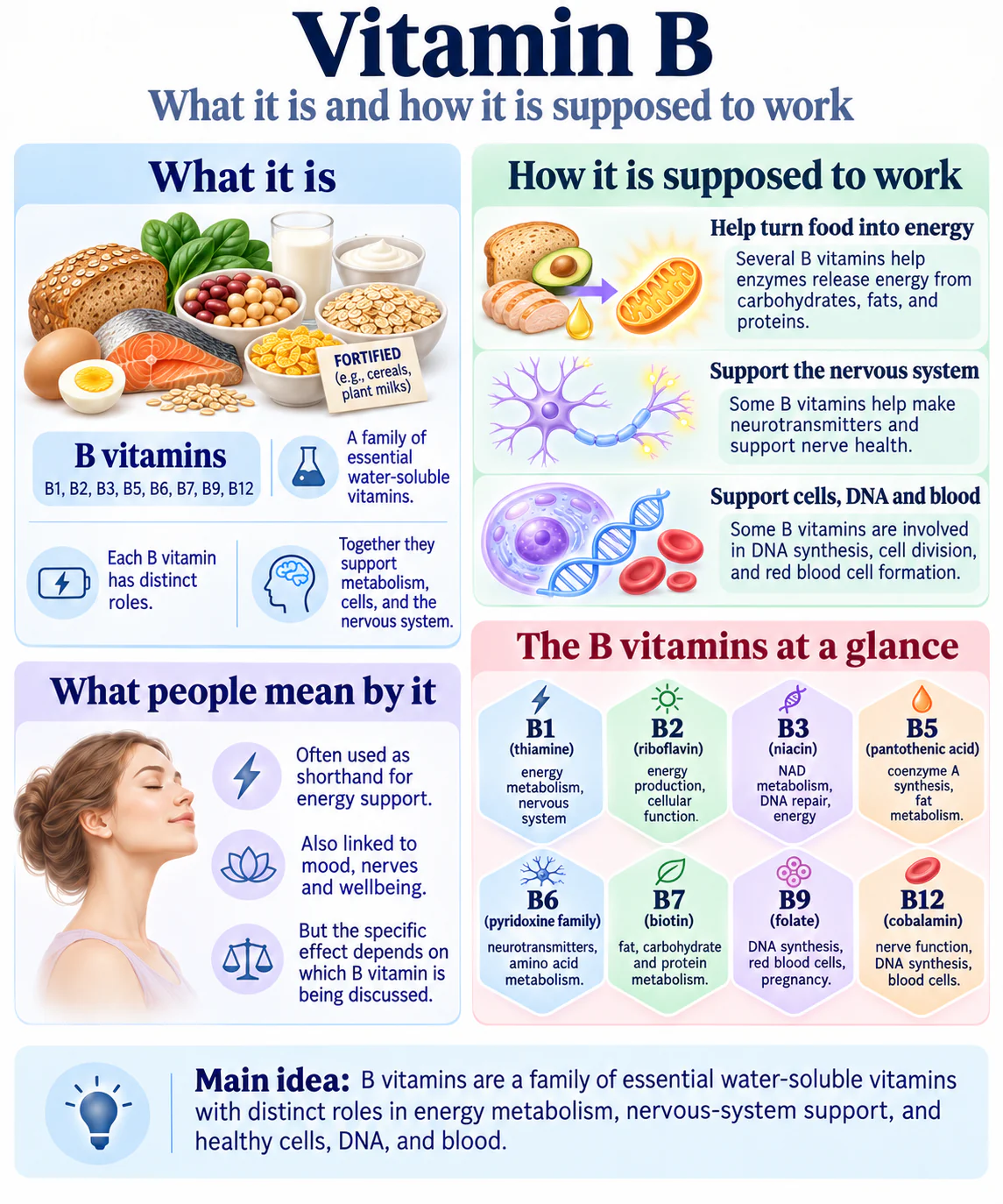
Read the image summary
The eight B vitamins are B1 (thiamine), B2 (riboflavin), B3 (niacin), B5 (pantothenic acid), B6, B7 (biotin), B9 (folate) and B12. They have distinct roles in metabolism, the nervous system and making cells. Sources include animal foods, leafy vegetables, beans and some fortified products. Biological roles do not establish that extra B vitamins improve mood or energy in people with adequate intake.
Illustrations
The image describes nutrient functions; it does not establish benefits from extra supplements.
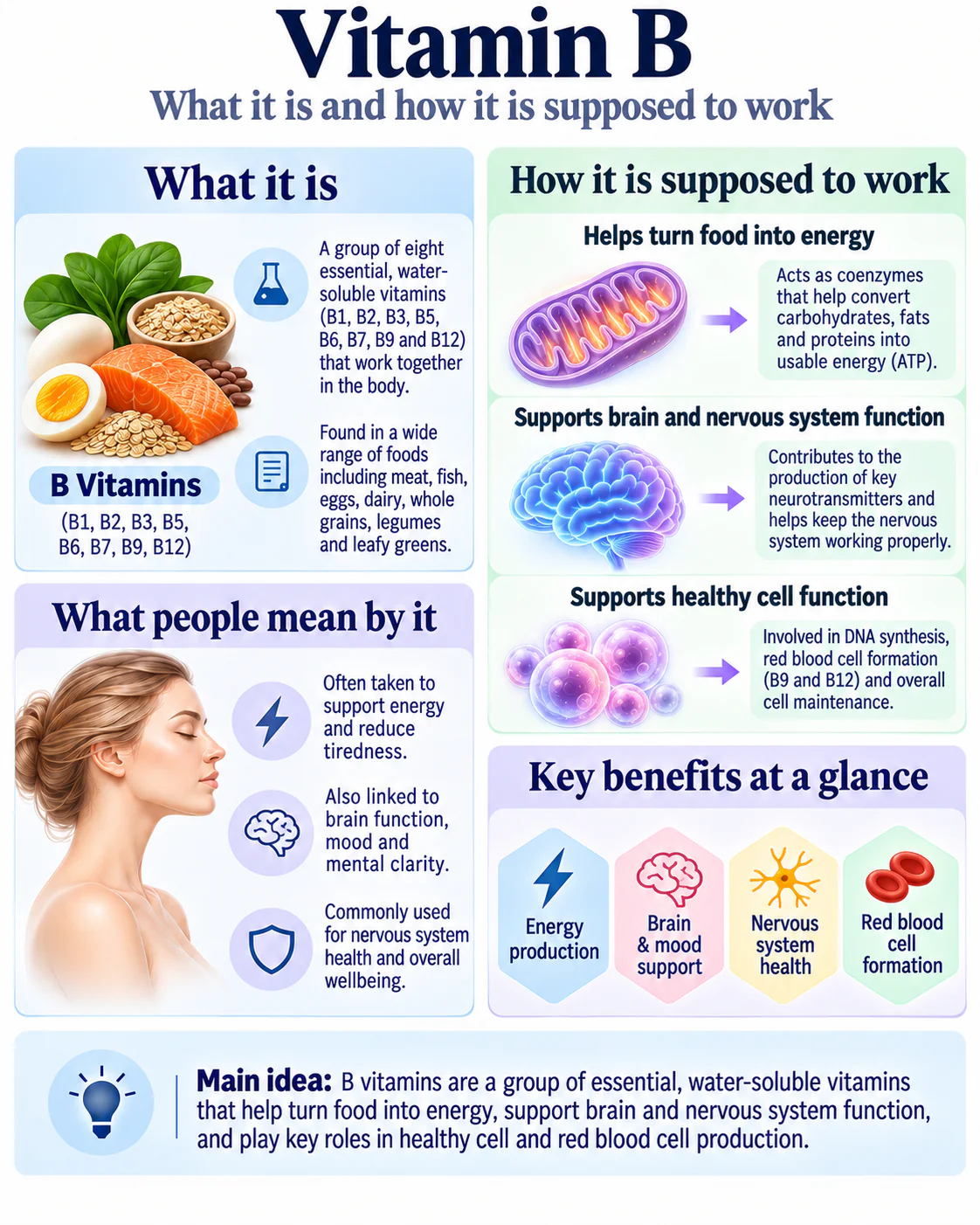 Open image at full size
Multivitamins are not one standard product
There is no single multivitamin formula. Products differ in nutrients, doses and forms, and labels may be designed for different ages or life stages. Compare the full Supplement Facts panel rather than relying on the product name.13
Can a multivitamin improve memory?
There is an encouraging but limited signal from a large trial; it does not establish that multivitamins prevent dementia. COSMOS-Web randomly assigned 3,960 older US adults to a particular multivitamin or placebo; 3,562 had a baseline and at least one follow-up assessment and were included in the reported analysis. On a 20-word immediate-recall test, the estimated difference in improvement after one year was 0.23 words in favour of the multivitamin group on average. Both groups improved, and a group average this small does not mean each person noticed a difference. There was no statistically significant improvement on the study’s other tests of memory retention, object recognition or executive function. The online-test participants were predominantly non-Hispanic White; results may not apply equally to other populations or formulas. Investigators estimated an age-equivalent comparison from cross-sectional data, but the trial did not show that anyone became years younger or avoided dementia. Funding included NIH and Mars Edge; Pfizer Consumer Healthcare, now Haleon, helped supply pills and packaging. Authors said funders did not direct the study or analysis. Memory changes have many causes, including some treatable deficiencies; see vitamin B12 and deficiency and seek clinical assessment for concerns.5
Do multivitamins prevent cancer?
In the Physicians’ Health Study II, 14,641 male US physicians aged 50 or older were randomly assigned a specific multivitamin or placebo. After a median of 11.2 years, the multivitamin group had a modestly lower rate of total cancer: 17.0 versus 18.3 diagnoses per 1,000 person-years, a measure that accounts for time followed. Some participants had previously had cancer. The trial tested one product in a particular population; it does not establish prevention of every cancer or benefit for everyone. NIH and supplement companies supported the study, and the multivitamin was supplied by its manufacturer.
A 2022 US Preventive Services Task Force recommendation judged the overall evidence insufficient to assess the balance of benefits and harms of multivitamins for preventing cancer or cardiovascular disease in the general adult population it considered. That question is different from correcting a deficiency or a specific pregnancy-related need.68
Do multivitamins help people live longer?
A 2024 observational analysis followed 390,124 US adults in three cohorts. Reported multivitamin use was not associated with a mortality benefit. Unlike a randomized trial, the study did not assign products: differences in health, diet, healthcare access or reasons for taking supplements can influence the comparison despite statistical adjustment. It does not prove supplements shorten life, nor does it exclude benefits for people with a specific deficiency or prove every formulation has the same effect.7
More can be harmful
Some vitamins and minerals accumulate or interfere with medicines. Interactions can matter with anticoagulants, thyroid medicines and other treatments; excess doses can cause toxicity. Pregnancy, childhood, kidney disease, surgery and diagnosed deficiencies warrant particular care from a qualified professional.342
A proportionate conclusion
A varied diet is the main source of nutrients for most people. A supplement may be useful for a specific reason, but a general claim that a multivitamin prevents chronic disease remains stronger than the broad evidence supports. Product quality and the actual ingredient list still need checking. Explore the individual B vitamins: B1, B2, B3, B5, B6, biotin (B7), folate (B9) and B12. For a familiar claim, see vitamin C and colds. For form-specific benefits and risks, see vitamin A and beta-carotene.12
Further reading
Trusted external resources selected to help explain this page. They open in a new tab.
- Multivitamin/mineral supplements ↗Explains what multivitamins contain, what studies show and where uncertainty remains.
- Multivitamin Supplementation Improves Memory in Older Adults: A Randomized Clinical Trial ↗Online recall trial in older adults; improvement was small and did not establish dementia prevention.
- Physicians’ Health Study II: multivitamins and cancer ↗Male US physicians aged 50 and older; one product, median 11.2 years.
- Multivitamin use and mortality in three cohorts ↗Associations cannot by themselves prove cause and effect.
- US preventive recommendation on vitamin and mineral supplements ↗Distinguishes general prevention from pregnancy and nutritional deficiency.
Sources, kept close.
Selected supporting sources; this is not a complete literature review.
- Multivitamin/mineral SupplementsNIH Office of Dietary Supplements · Evidence review for health professionals
- Dietary Supplements: What You Need to KnowNIH Office of Dietary Supplements · Authoritative public-health reference
- FDA 101: Dietary SupplementsU.S. Food and Drug Administration · Regulator consumer guidance
- Questions and Answers on Dietary SupplementsU.S. Food and Drug Administration · Regulator consumer guidance
- Multivitamin Supplementation Improves Memory in Older Adults: A Randomized Clinical TrialAmerican Journal of Clinical Nutrition / PubMed Central · 2023 US randomized placebo-controlled trial, COSMOS-Web ancillary study
- Multivitamins in the prevention of cancer in men: the Physicians’ Health Study II randomized controlled trialJAMA / PubMed · Primary randomized clinical trial, 2012
- Multivitamin Use and Mortality Risk in 3 Prospective US CohortsJAMA Network Open / PubMed · Primary observational cohort study, 2024
- Vitamin, Mineral, and Multivitamin Supplementation to Prevent Cardiovascular Disease and Cancer: Preventive MedicationUS Preventive Services Task Force · US preventive recommendation, 2022