
The answer so far
For a cold question, separate preventing a cold, shortening symptoms and correcting deficiency. Vitamin C’s roles in collagen, immunity and iron absorption do not prove that extra supplements prevent every infection.
Vitamin C is an essential nutrient, but regularly taking a supplement does not appear to prevent colds for most people. Some studies suggest regular use can modestly shorten colds on average; starting after symptoms begin has not shown consistent benefit. Nutritional needs and individual treatment are separate questions.12
On this page
What vitamin C does
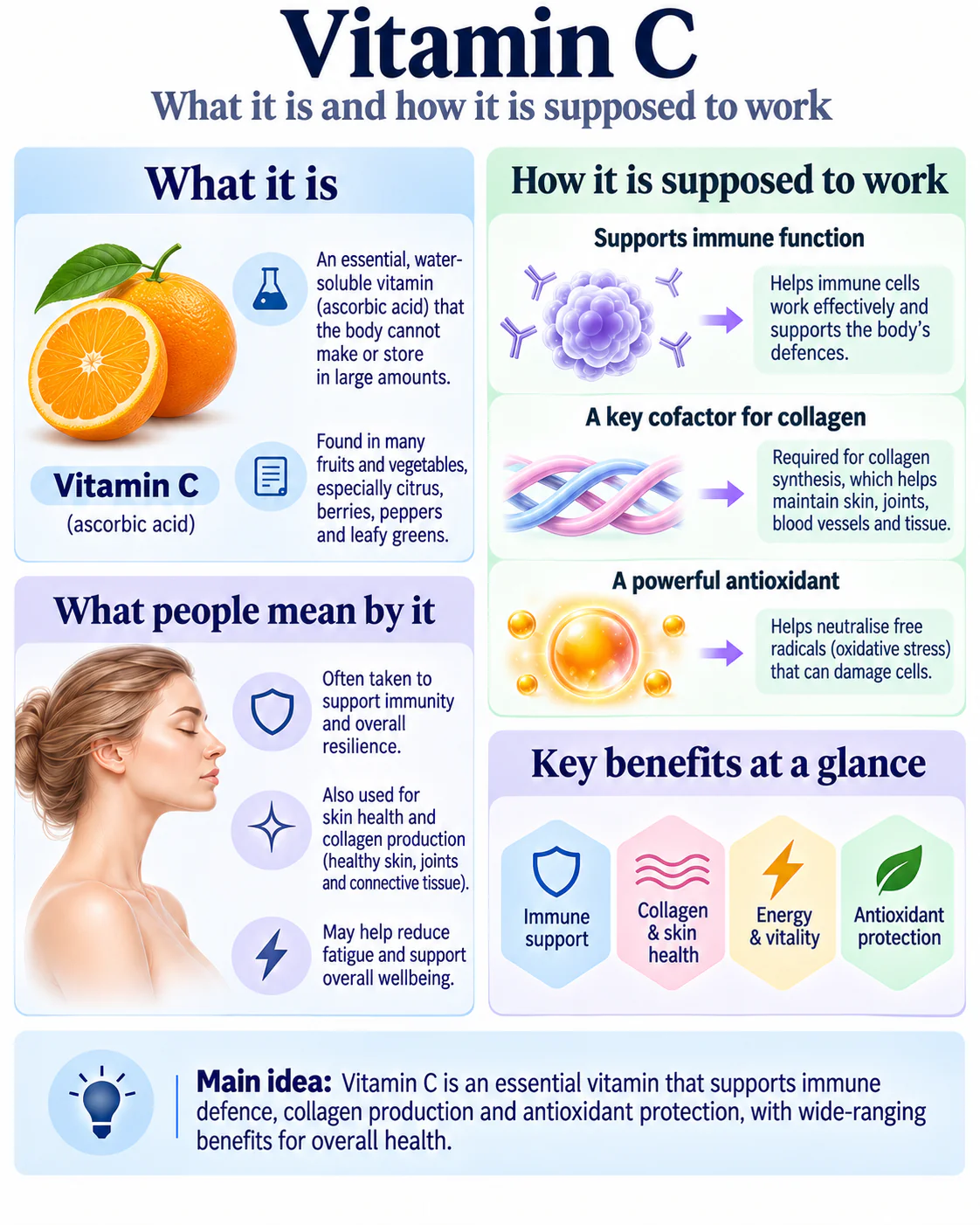
Vitamin C helps make collagen, supports normal immune function and increases absorption of iron from plant foods. Fruits and vegetables can provide it; prolonged severe deficiency causes scurvy. A nutrient’s role in immunity does not prove that extra supplements prevent every infection. See iron and nutrition for related context. For storage questions, see how to store vitamins and minerals. For the separate tendon-recovery claim, see what collagen and vitamin C studies measured.1
Illustrations
The image describes nutrient functions; it does not establish benefits from extra supplements.
 Open image at full size
Does regular vitamin C prevent colds?
A 2013 review of placebo-controlled trials found that regular vitamin C supplementation did not significantly reduce cold incidence in the general population. In a small set of studies involving people exposed to intense physical stress, the result differed; those participants are not a substitute for the general population. Products, diets and baseline status vary, so this evidence does not establish a benefit for every person. The review searched for studies through November 2012 and included trials testing at least 200 mg a day; this describes the evidence reviewed, not a personal dose recommendation.21
What about duration or starting after symptoms?
In the same review, regular supplementation was associated with a shorter average cold duration: about 8% in adults and 14% in children across the included trials. These are relative averages, not a guaranteed number of days saved for an individual. Trials starting supplementation only after symptoms began did not find a consistent benefit. The review studied particular doses and populations, not every product. For a different cold remedy, read about zinc and colds.
A 2023 analysis of 15 comparisons from 10 trials estimated a 15% average reduction in a combined measure of cold severity with vitamin C versus placebo. It pooled different outcomes, including symptom scores and time confined at home or absent from school; those are not interchangeable measures of how a person feels. Most comparisons involved regular supplementation, and the authors selected trials reporting both duration and severity. The review was not preregistered. Its estimate does not establish that starting vitamin C after symptoms begin will help, or predict an individual result.217
Can vitamin C supplements cause kidney stones?
Possibly in some circumstances, but the evidence does not establish the risk for every person. Some vitamin C can be converted to oxalate, a substance involved in the formation of some kidney stones. The US National Institutes of Health says studies of vitamin C and urinary oxalate have produced conflicting results, and highlights particular concern for people with existing high urinary oxalate.
In a Swedish observational study of 23,355 men without a previous kidney-stone diagnosis, researchers compared men who reported taking vitamin C supplements alone with men who reported taking no supplements. Over approximately 11 years, recorded first stones occurred at rates of about 310 versus 163 per 100,000 person-years, respectively. A person-year is one person followed for one year, so these are rates over accumulated follow-up, not percentages of the men. Supplement use was self-reported; the men were not randomly assigned, and other differences could explain part of the association. The study does not prove that vitamin C caused the stones, determine risk in women or children, or establish a safe amount for someone with a history of stones.
Food sources and concentrated supplements are different exposures. If you have had kidney stones, kidney disease or high urinary oxalate, discuss supplements and the specific product with a clinician. Severe pain, fever or chills with urinary symptoms, or difficulty passing urine warrants urgent medical help immediately.456
Too much and interactions
High supplemental amounts can cause diarrhoea, nausea or abdominal cramps. Vitamin C increases iron absorption, so people with iron overload conditions should discuss supplements with a clinician. Product ingredients and medicines matter too; seek individual advice for ongoing symptoms or health conditions. This page does not recommend a product or dose. See supplement interactions and how to read a label.
US guidance sets an adult upper limit of 2,000 mg a day from food and supplements combined; it is not a target, and limits differ by age. It does not apply to vitamin C used as medical treatment under a clinician’s care. NIH advises people receiving chemotherapy or radiation to consult their cancer specialist before taking vitamin C or other antioxidant supplements, especially at high doses; possible effects on treatment remain uncertain.13
Further reading
Trusted external resources selected to help explain this page. They open in a new tab.
- Vitamin C: consumer fact sheet ↗US nutrition evidence summary; individual health circumstances differ.
- Vitamin C for preventing and treating the common cold ↗Distinguishes regular supplementation from starting after symptoms begin.
- Vitamin C reduces the severity of common colds: a meta-analysis ↗Different outcome measures and mostly regular supplementation; not a trial of an individual product.
Sources, kept close.
Selected supporting sources; this is not a complete literature review.
- Vitamin C: Consumer Fact SheetNIH Office of Dietary Supplements · Official nutrition and safety summary; United States
- Vitamin C for preventing and treating the common coldCochrane Database of Systematic Reviews / PubMed · Systematic review of placebo-controlled trials; 2013
- Mixing Medications and Dietary Supplements Can Endanger Your HealthU.S. Food and Drug Administration · Regulator consumer guidance
- Ascorbic Acid Supplements and Kidney Stone Incidence Among Men: A Prospective StudyJAMA Internal Medicine · Prospective observational cohort
- Vitamin C: Health Professional Fact SheetNIH Office of Dietary Supplements · Official nutrition evidence summary
- Symptoms & Causes of Kidney StonesUS National Institute of Diabetes and Digestive and Kidney Diseases · US patient health information
- Vitamin C reduces the severity of common colds: a meta-analysisBMC Public Health · 2023 systematic review and meta-analysis; different severity measures; not preregistered