
Substance profile
Cannabidiol (CBD).
A plain-language guide to cannabidiol: what the compound is, why products differ, and what human evidence can—and cannot—show.
9 min read
A plain-language introduction to cannabinoids, the body’s endocannabinoid signalling system, and why product labels do not answer every evidence question.
Readability reviewed 6 Nov 2026
Prepared is when this page was drafted. A readability review checks clarity. Dates alongside individual sources record when those sources were accessed or checked. Read our editorial standards →
Cannabis contains multiple cannabinoids. Delta-9-THC is the main intoxicating cannabinoid in ordinary cannabis. Cannabidiol, or CBD, does not cause THC’s typical intoxication, but it is not risk-free. A purified compound, plant extract and retail product are not interchangeable. Their form, how they are taken, concentration, contaminants and stability can all matter.314
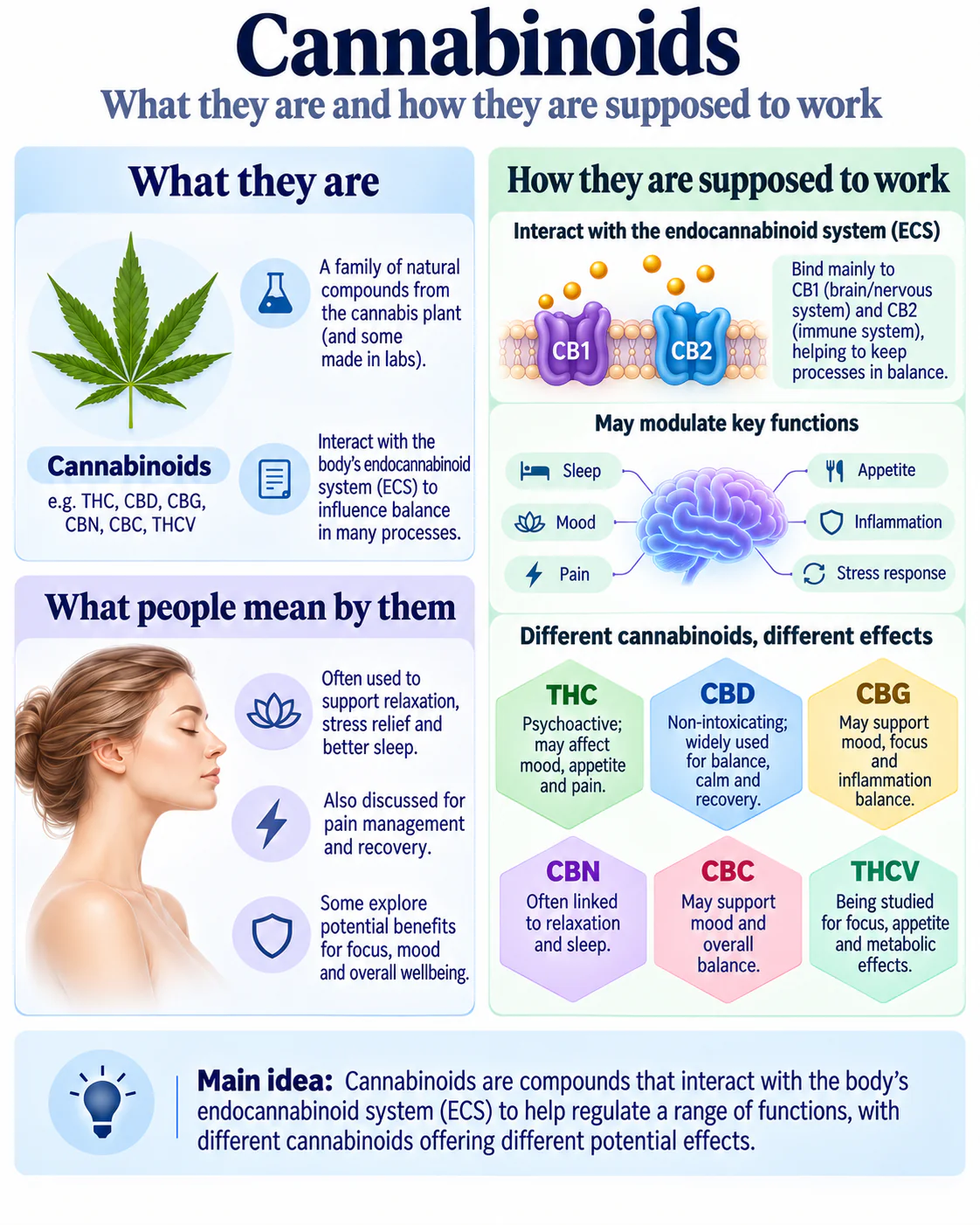
CBD does not simply act by binding CB1 or CB2; see the article for the limits of this simplified diagram.
 Open image at full size
The body makes its own signalling molecules, including anandamide. Together with receptors, they form part of the endocannabinoid system that helps cells communicate. THC can activate cannabinoid receptors in the brain, affecting memory, coordination and perception.
CBD should not be assumed to work the same way. The FDA label for the prescription medicine Epidiolex says its precise antiseizure mechanisms in humans are unknown and do not appear to depend on interaction with cannabinoid receptors. This does not establish that a retail product treats a condition. See how receptors and responses differ.78
Studies of receptors, cells and animals can explain why researchers ask a question. They do not by themselves show that people feel better, function better or avoid a serious outcome. A clinical result belongs to the product, people, comparison, outcome and follow-up studied. Evidence for one regulated medicine does not automatically transfer to every product called cannabis or CBD.35
FDA has approved particular cannabis-derived or cannabis-related medicines for defined indications, including purified CBD, dronabinol and nabilone. That does not make unapproved retail products equivalent to those medicines. FDA states that THC and CBD products are excluded from the federal dietary-supplement definition under the drug-exclusion provision; hemp-seed ingredients have a separate food history. Federal, state and local rules can differ.1526
THC can impair attention, reaction time and memory, and may cause anxiety, paranoia or other unwanted effects. CBD has different safety concerns, including liver injury identified during development of Epidiolex and possible medicine interactions. Risk depends on the product, amount, route, age, previous exposure, other substances and health. “Natural,” “hemp-derived” or “low THC” does not establish safety.436
An approval is a decision about a named product, indication, population and conditions of use. It is not a declaration that cannabis is broadly approved as a treatment. EU and member-state decisions can differ, as can rules for possession, prescribing and research. If a headline omits the jurisdiction and product, the claim is incomplete.12
A cannabinoid can reach the body differently when inhaled, swallowed, absorbed through the mouth or applied to skin. Onset, absorption, peak concentration and duration can differ. A study of inhaled THC cannot automatically tell you what an edible will do. A claim about a cream needs evidence that its ingredient reaches the relevant tissue. Compare the product, route, timing and measurements before treating studies as equivalent.348
Name the product before drawing a conclusion about the category. Purified cannabidiol (CBD) medicines such as Epidiolex or Epidyolex are prescription products studied and authorised for defined indications and populations; that evidence does not automatically apply to retail oils, gummies or topicals. In the United States, FDA also lists dronabinol products (Marinol and Syndros) and nabilone (Cesamet) as named prescription cannabinoid-related products with defined uses. Those U.S. examples do not establish authorization or labeling in another jurisdiction. A claim about sleep, anxiety, pain or wellbeing needs its own product, population, comparator, outcome and follow-up evidence rather than a general citation to cannabis.1265
A prescription CBD medicine is a defined formulation with specified manufacturing controls, pharmacokinetics, dosing instructions and clinical trials in named conditions. A retail CBD product may differ in concentration, route, contaminants, labelling accuracy and stability. The shared molecule does not make the evidence interchangeable. To evaluate a claim, ask which product was tested, how exposure was measured, what outcome was prespecified and what regulator record applies. This is not a conclusion that every retail product is harmful; it is a reason not to infer retail effectiveness or safety from a prescription trial.465
Which compound and product were studied? Was it a purified, quality-controlled product or a variable extract? Who took part, what was it compared with and what was measured? What harms, interactions and follow-up limits were reported? Which regulator, country and use does an approval claim actually describe?35
A plain-language guide to cannabidiol: what the compound is, why products differ, and what human evidence can—and cannot—show.
A specific cannabinoid—not a synonym for every cannabis product.
A useful experiment answers one question. A useful treatment has to answer several.
What small clinical trials found, why mixtures are hard to interpret and what safety questions remain.
Trusted external resources selected to help explain this page. They open in a new tab.
Not necessarily an organ. Often, it is a particular piece of molecular machinery.
A decision about a defined product and use is not a universal endorsement of a molecule.
Selected supporting sources; this is not a complete literature review.