
The answer so far
Vitamin E is a fat-soluble nutrient that helps protect cells and supports normal body functions. Many foods provide it. The fact that it acts as an antioxidant does not prove that high-dose supplements prevent cancer; a large trial found increased prostate cancer risk with one vitamin E supplement in its studied population.13
On this page
What vitamin E does and where it is found
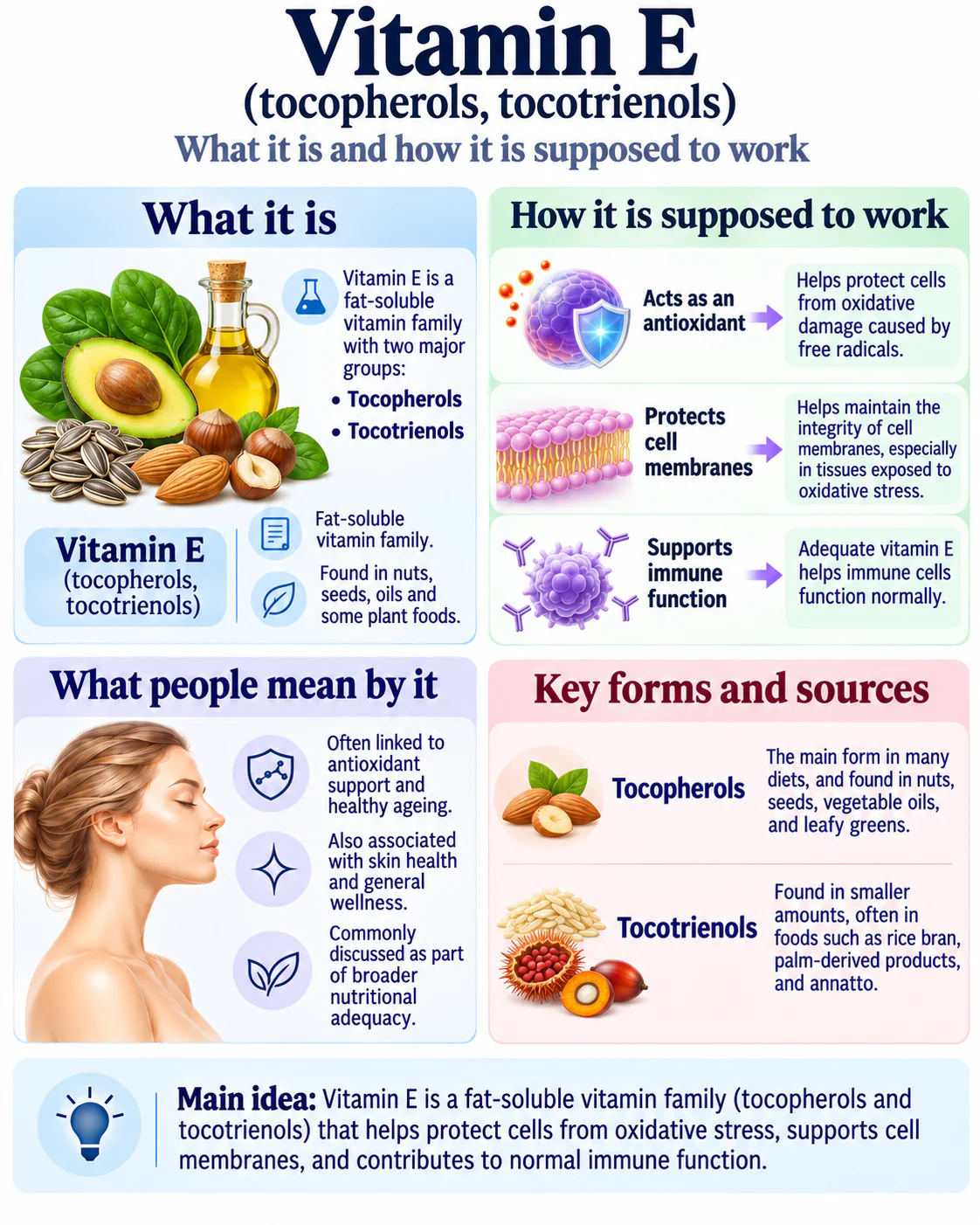
Vitamin E is a name for several related compounds; alpha-tocopherol is the form recognised as meeting human requirements. It helps protect cells from some forms of oxidative damage and contributes to immune function. Vegetable oils, nuts, seeds and some greens are sources. A nutrient’s normal function is not itself proof that extra supplementation prevents disease.1
As a US dietary reference, healthy adults aged 19 and older need 15 mg of alpha-tocopherol a day, including during pregnancy; the reference while breastfeeding is 19 mg. These amounts cover total intake, not a supplement or treatment dose. Guidance and individual needs can vary.8
Illustrations
The image describes nutrient functions; it does not establish benefits from extra supplements.
 Open image at full size
What SELECT found
SELECT randomly assigned 35,533 men to vitamin E, selenium, both or placebo. In later follow-up, more prostate cancers were diagnosed in the vitamin-E-only group than in the placebo group. The US National Cancer Institute describes this as about 76 versus 65 diagnoses per 1,000 men over roughly seven years—around 11 additional diagnoses per 1,000 in this comparison. This was a particular high-dose supplement and population; it does not show that vitamin E in food causes cancer or that every supplement has the same effect. Read more in the selenium profile.
The trial used a particular form, dl-alpha-tocopheryl acetate, at 400 international units daily; this describes the study, not a recommended intake. In 2008 an independent monitoring committee found that the supplements did not prevent prostate cancer, and participants were told to stop taking them. The 2011 analysis included an average of about 5.5 years on study supplements and another 1.5 years of follow-up after stopping. The vitamin-E-only comparison then showed a statistically significant increase in diagnoses. This timeline does not tell an individual whether or when any effect would disappear after stopping a different product.34
Deficiency and excess are different questions
Vitamin E deficiency is uncommon and can occur in certain conditions that impair fat absorption. It needs clinical assessment. High-dose vitamin E supplements can increase bleeding risk, especially with anticoagulant or antiplatelet medicines. Discuss supplements and medicines with a pharmacist or clinician, particularly before changing a prescribed treatment. Food sources and concentrated supplements should not be treated as equivalent exposures.15
US guidance sets an adult upper limit of 1,000 mg a day for supplemental alpha-tocopherol; it is not a target or a guarantee of safety. Some trials of vitamin E supplements reported more haemorrhagic strokes, including at amounts below that limit. Risk and appropriate care depend on the person and other medicines.8
Some eye supplements contain high amounts of vitamin E with zinc and other ingredients. The AREDS and AREDS2 guide explains which formulas and eye conditions were studied.6
If you are receiving cancer treatment, discuss vitamin E and other supplements with your cancer care team before starting or changing them. The US National Cancer Institute says studies of antioxidant supplements during cancer treatment have had mixed results, with worse outcomes in some studies. That does not establish the effect of every product or treatment; the team can review the specific supplement alongside your care.7
Read the whole product
Labels can use different units and list vitamin E alongside other nutrients. Check serving size, ingredients and overlap with other products; an antioxidant claim is not a clinical outcome. The supplement label guide and interaction guide provide context. This page does not recommend a product or dose.
For US label calculations, 400 IU of synthetic alpha-tocopherol corresponds to 180 mg of labelled alpha-tocopherol, while 400 IU of natural alpha-tocopherol corresponds to 268 mg. These are form-specific label conversions, not a recommendation to take either amount. Check the ingredient and serving size; do not treat IU and mg as interchangeable numbers.12
Further reading
Trusted external resources selected to help explain this page. They open in a new tab.
- Vitamin E: consumer fact sheet ↗US nutrition guidance; personal requirements and products differ.
- SELECT trial: questions and answers ↗Specific supplements in the studied population, not a test of vitamin E from food.
- Vitamin E and prostate cancer risk: SELECT follow-up ↗A randomised prevention trial with follow-up after participants stopped study supplements.
Sources, kept close.
Selected supporting sources; this is not a complete literature review.
- Vitamin E: Consumer Fact SheetNIH Office of Dietary Supplements · Official nutrition and safety summary; United States
- Converting Units of Measure for Folate, Niacin, and Vitamins A, D, and E on the Nutrition and Supplement Facts LabelsUS Food and Drug Administration · US guidance for industry on nutrition and supplement labels
- Vitamin E and the risk of prostate cancer: SELECT follow-upJAMA / PubMed · Randomised trial follow-up report; United States, Canada and Puerto Rico; 2011
- Selenium and Vitamin E Cancer Prevention Trial: Questions and AnswersU.S. National Cancer Institute · Official trial explanation and follow-up summary; United States
- Mixing Medications and Dietary Supplements Can Endanger Your HealthU.S. Food and Drug Administration · Regulator consumer guidance
- AREDS and AREDS2 frequently asked questionsNational Eye Institute · US government evidence summary, medicine interactions and trial questions
- Antioxidants and Cancer PreventionU.S. National Cancer Institute · Official research evidence summary; United States
- Vitamin E: Health Professional Fact SheetUS NIH Office of Dietary Supplements · Official nutrition and safety evidence summary