
The answer so far
GLOW is a seller-defined blend, so start with the actual ingredient list and route. Evidence for one peptide or topical product does not establish the safety or benefit of the whole stack.
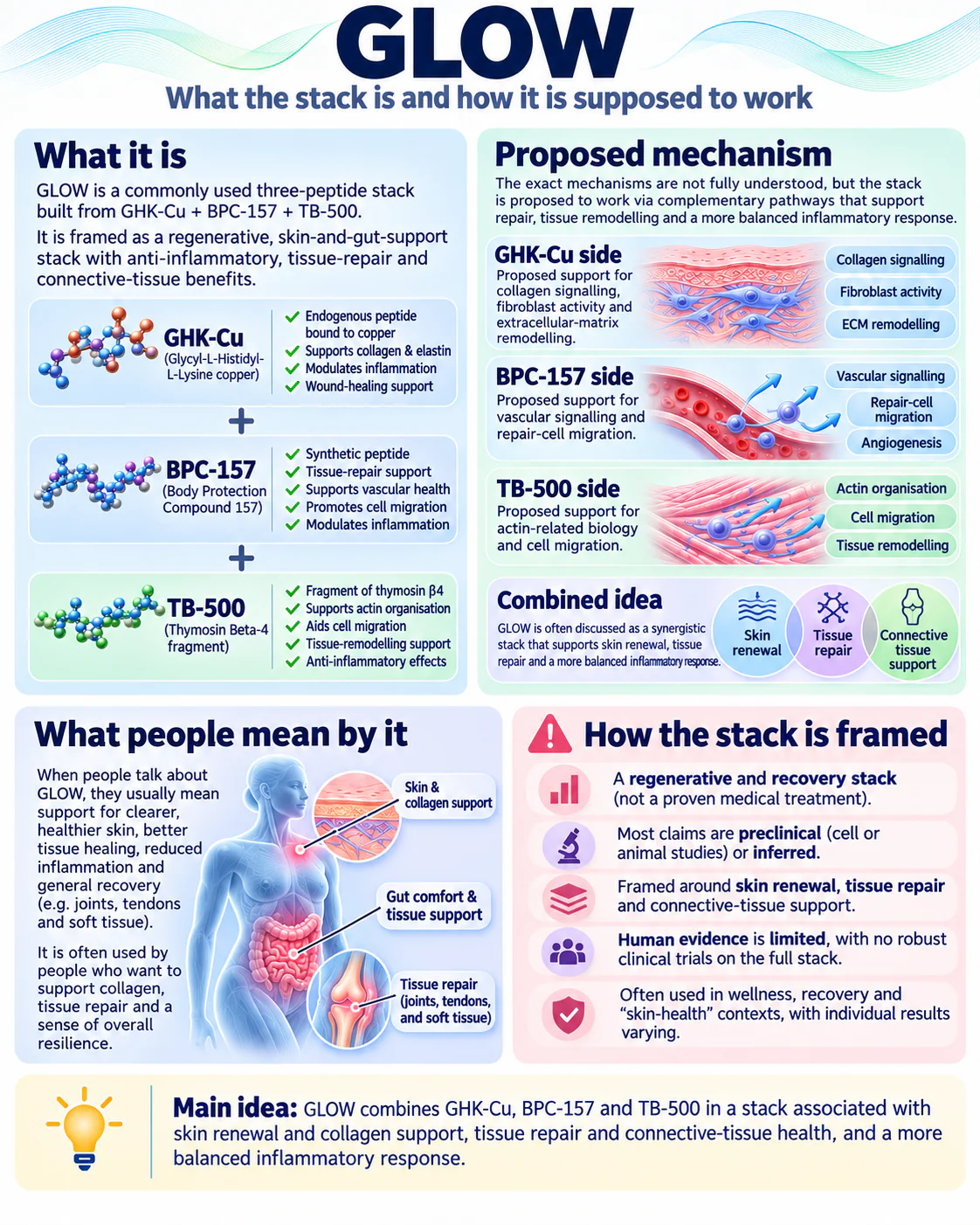
GLOW is a seller-defined peptide blend often discussed for skin appearance, hair and recovery. One common formula combines GHK-Cu, BPC-157 and TB-500. The idea draws on different lines of research, but there is no established controlled human evidence that the complete blend achieves those aims. Formulas vary.125
On this page
Why people look at GLOW
People often encounter GLOW while exploring skin appearance, hair or recovery. The blend combines a copper peptide found in some cosmetic products with other peptides studied in models of tissue repair. This describes the proposed purpose, not a demonstrated result from the complete blend. Compare GHK-Cu, GLOW and KLOW, including why a serum and a vial are not interchangeable.
To understand one ingredient and its longer molecular relative, see TB-500 and thymosin beta-4.
For the proposed role of each ingredient and the evidence behind it, see how GLOW and KLOW are meant to work.8
Illustrations
Mechanisms and repair claims are hypotheses or early research, not established clinical benefits. Ingredients and products vary.
 Open image at full size
What the name usually refers to
A seller uses GLOW for GHK-Cu, BPC-157 and TB-500, but the name is not a regulator-defined formulation. One seller's certificate of analysis describes a specific batch; it does not show that every product sold under the name has the same ingredients or quality. Treat the displayed composition as a seller claim that must be checked against the exact batch and jurisdiction. See storage claims, product quality and travel for practical context.1
Read what a certificate of analysis can and cannot establish.
What can be learned from the ingredients
GHK-Cu, BPC-157 and TB-500 are different molecules with different proposed mechanisms. Laboratory or animal findings can suggest questions about wound repair, cell migration or inflammation, but those findings do not transfer automatically to a mixed product in people. Mixing ingredients can change how much reaches the body, how the ingredients interact and the risks to the immune system. Evidence about each ingredient separately does not establish that the stack works.25
Safety and product quality
For injectable compounded products containing BPC-157, injectable GHK-Cu or TB-500, FDA materials describe concerns including peptide impurities, aggregation and immunogenicity; for KPV, which is added in some KLOW blends, FDA also reports no identified human exposure data in drug products. Sterility, storage, reconstitution and dose accuracy add risks that a marketing name cannot resolve. Do not treat 'research use only' wording as proof of safety or permission for human use.238
In the US, a draft policy describes conditions for certain single-ingredient compounded peptide products. A blend with multiple active ingredients does not meet that condition. The policy is not FDA approval; see the US policy section below for its scope and limits.67
If you have already injected a product and the skin is painful, hot and swollen, seek urgent medical advice; these signs can have different causes, including infection. Sudden swelling of the lips, mouth, tongue or throat, or difficulty breathing, needs emergency help immediately. Tell the clinician what you used and, if available, bring its packaging. See injection-site reactions and when to seek help.910
What evidence would change the picture
A useful test would specify the exact formulation, manufacturing controls, route, dose, comparison group, outcomes, follow-up and harms, then report the results transparently. Studies of a single ingredient or a different formulation cannot answer whether GLOW itself improves a patient-important outcome. Until such evidence exists, the appropriate description is an unstandardised marketed combination with substantial uncertainty.45
Questions to ask when you see a claim
Which ingredients and chemical forms are present in the specific product? Is the product intended for people, and under what regulator and indication? Is there independent testing for identity, purity, potency, sterility and endotoxin? Was the exact combination studied in humans against a meaningful comparator? What harms and missing data were reported? A confident testimonial cannot answer these questions.24
U.S. compounding policy: a narrow interim position
This US draft policy concerns certain single-ingredient compounded products. It does not approve this blend or establish that it is safe or effective.
In October 2026 HHS published a draft interim enforcement-discretion policy covering specified forms of BPC-157, TB-500, KPV, epitalon, MOTS-c and Semax in section 503A compounding. GHK-Cu is not among the substances listed in Appendix A. Appendix B identifies the chemical form and routes addressed for each listed peptide; the policy also describes conditions including a patient-specific prescription, ingredient characterization and a single active ingredient. It is a statement of enforcement intent, not FDA approval or proof of safety or effectiveness; it does not establish the legality or quality of an online vial or a multi-ingredient stack. Read the peptide overview and the linked HHS policy for the specific conditions. Checked 5 November 2026. For the single-ingredient condition and its context, see the US policy guide.7
Further reading
Trusted external resources selected to help explain this page. They open in a new tab.
Sources, kept close.
Selected supporting sources; this is not a complete literature review.
- Glow Stack batch certificate of analysisCellgenic · Seller-provided product record
- Certain bulk drug substances that may present significant safety risksU.S. Food and Drug Administration · Regulator record
- FDA briefing document: peptide bulk drug substancesU.S. Food and Drug Administration · Regulator briefing document
- Clinical pharmacology considerations for peptide drug productsU.S. Food and Drug Administration · Regulatory guidance
- Concerns regarding public health risks associated with unapproved peptide productsTherapeutic Goods Administration · Regulator safety communication
- Enforcement Discretion Policy Regarding 503A Compounding Using Certain Peptide Bulk Drug SubstancesU.S. Department of Health and Human Services / Federal Register · Interim enforcement-discretion policy notice; not FDA approval or final rule
- HHS Enforcement Discretion Policy Regarding 503A Compounding Using Certain Peptide Bulk Drug SubstancesU.S. Department of Health and Human Services · Policy PDF; Appendix A/B conditions and scope
- KLOW and GLOW peptide blends: what is in each vialCondor Research (seller) · Seller description; not clinical evidence
- CellulitisNHS · Official clinical guidance
- AnaphylaxisNHS · Official clinical guidance