
The answer so far
A stack is a combination, not a shortcut to evidence. If the exact mixture has not been tested in people, studies of its individual ingredients cannot show that the blend works, is compatible or is safe to inject.
Names such as GLOW and KLOW are seller-defined labels rather than regulator-defined formulations. Ingredients, salts, amounts, route and manufacturing can vary. Adding a peptide adds possible interactions, stability questions, immune exposure and more ways for a product to differ from its label.13
On this page
The exact product is the intervention
A trial of one peptide does not test a stack. To interpret a combination, readers need the exact ingredients, chemical forms, concentrations, route, manufacturing controls and comparator. A seller's recipe or batch certificate describes one product record; it does not establish every vial sold under a name.3
Illustrations
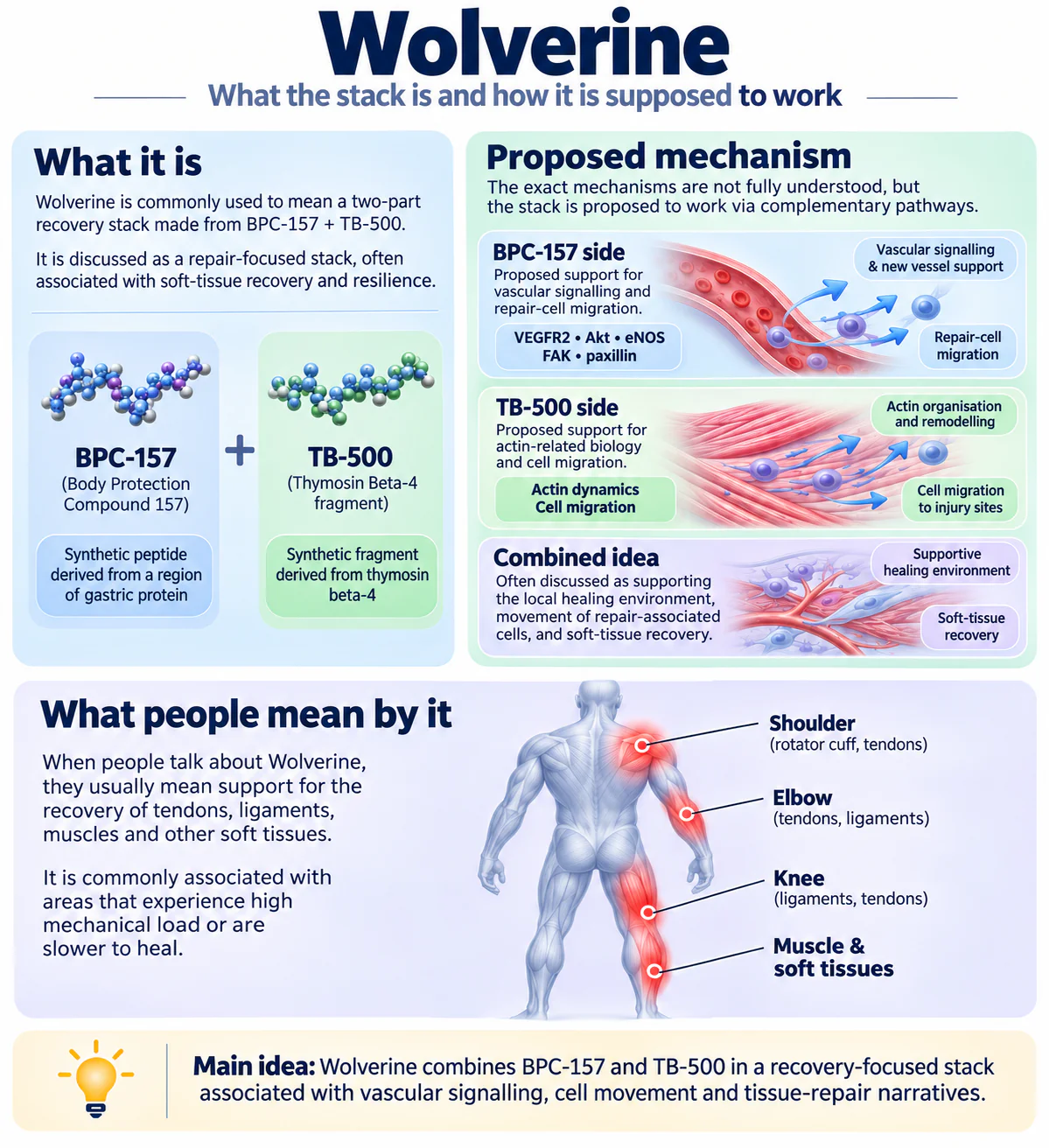
Stack benefits are unproven, formulations vary, and the elbow label in the original image is misplaced.
 Open image at full size
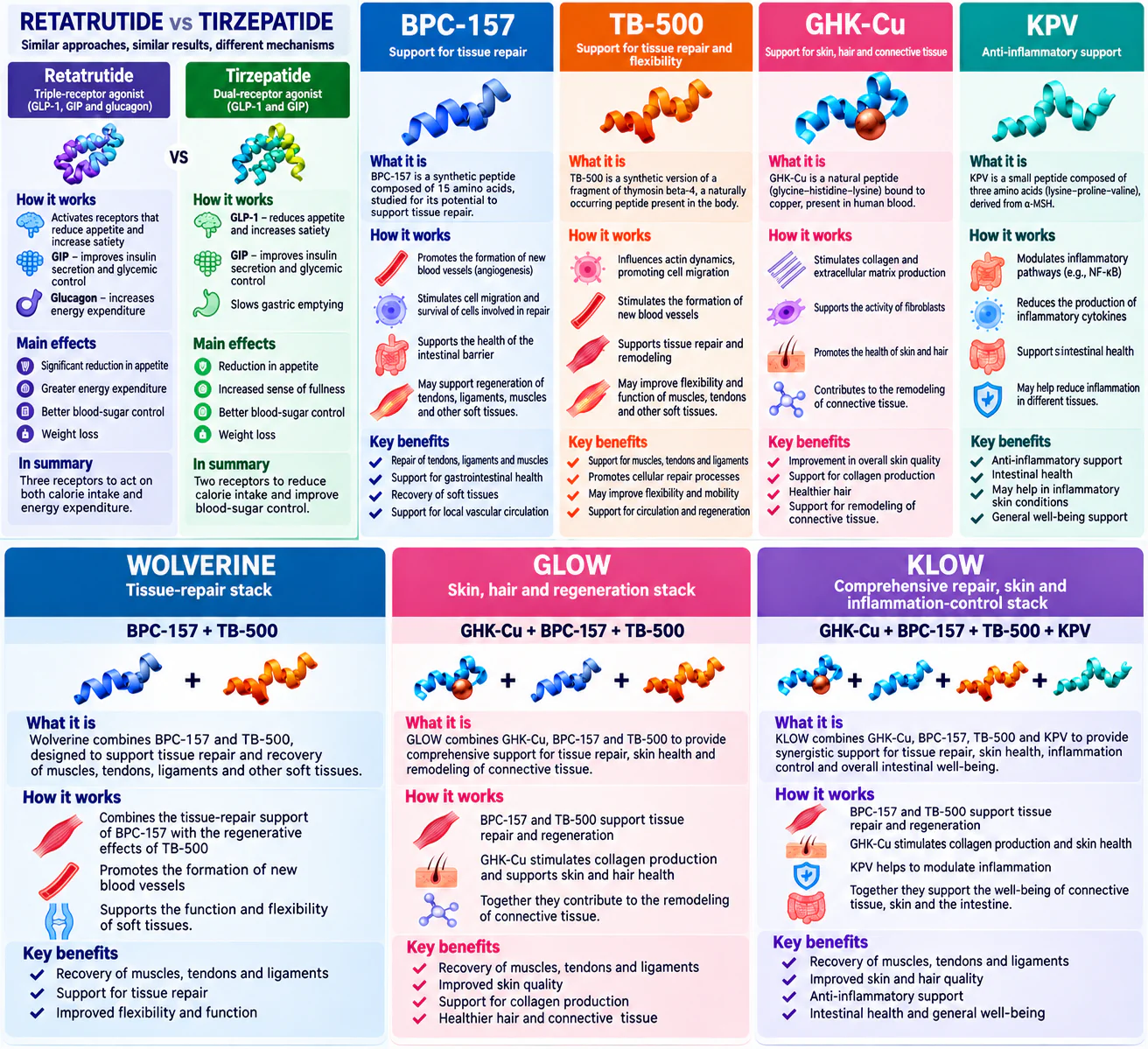
Mechanisms and repair claims are hypotheses or early research, not established clinical benefits. Ingredients and products vary.
 Open image at full size
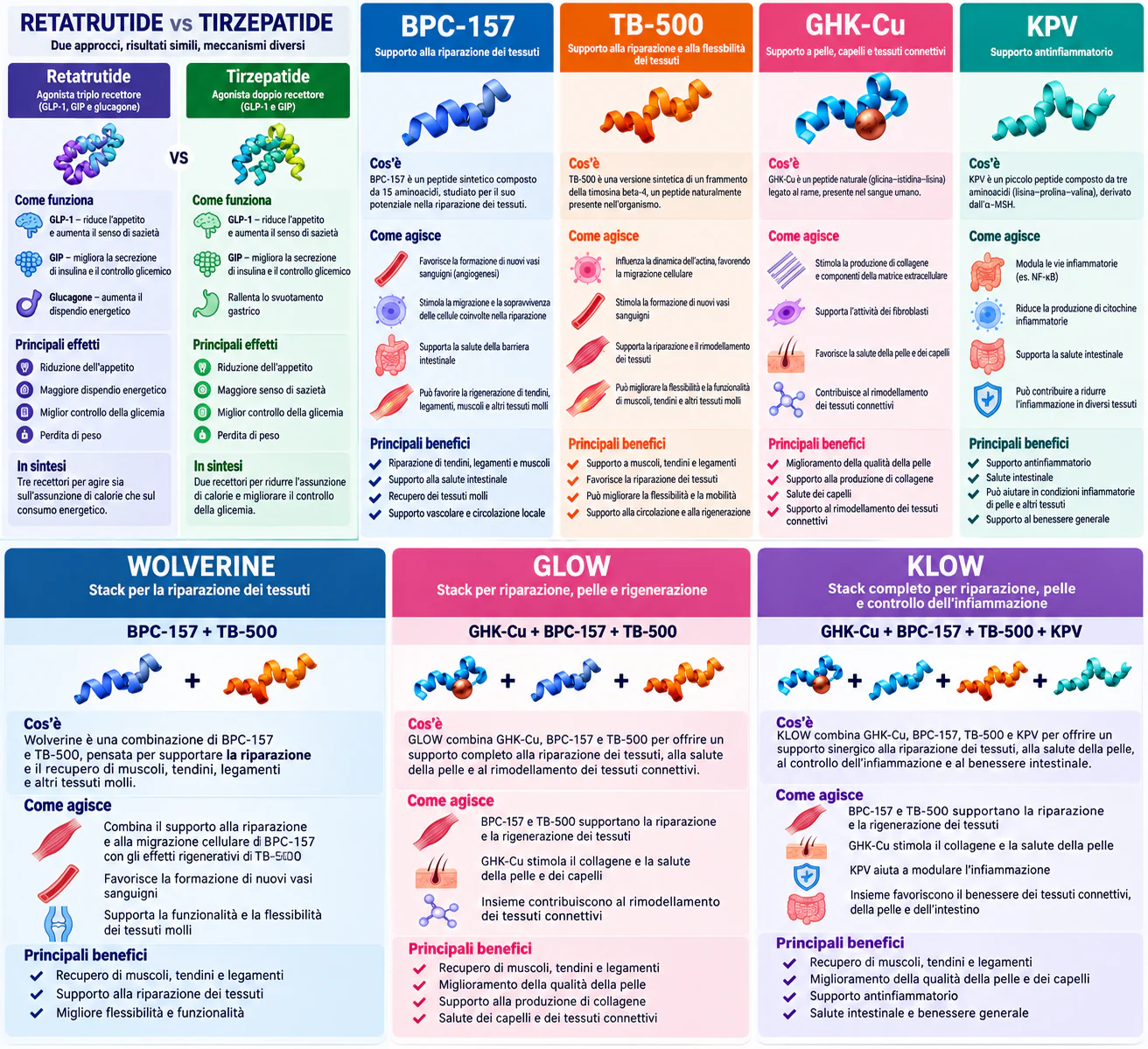
Mechanisms and repair claims are hypotheses or early research, not established clinical benefits. Ingredients and products vary.
 Open image at full size
More ingredients mean more unknowns
A combination can create questions about compatibility, aggregation, immune reactions and whether one component changes exposure to another. These are reasons to test a mixture directly, not evidence that it is dangerous in every case or beneficial because its ingredients sound complementary.12
What quality evidence would look like
A credible stack study would use a reproducible formulation, independent manufacturing oversight, a suitable comparator and pre-specified outcomes and harms. Testimonials, influencer before-and-after images and a certificate of analysis cannot answer the clinical question.4
A practical reading checklist
Ask who defines the formula, whether the exact combination has been tested in humans, whether identity and sterility testing is independent, which regulator has assessed it, and what harms and missing data were reported. A “research use only” label does not establish that a product is suitable or safe for human injection. Ask a qualified clinician about the specific product. If the answers are unavailable, the right conclusion is uncertainty.416
U.S. compounding policy: a narrow interim position
In October 2026 HHS published a draft interim enforcement-discretion policy covering specified forms of BPC-157, TB-500, KPV, epitalon, MOTS-c and Semax in section 503A compounding. Its Appendix B identifies the chemical form and routes addressed for each peptide; the policy also describes conditions including a patient-specific prescription, ingredient characterization and a single active ingredient. It is a statement of enforcement intent, not FDA approval or proof of safety or effectiveness; it does not establish the legality or quality of an online vial or a multi-ingredient stack. Read the peptide overview and the linked HHS policy for the specific conditions. Checked 5 November 2026. For the conditions and the separate 2027 advisory discussion, see the US policy guide.5
Further reading
Trusted external resources selected to help explain this page. They open in a new tab.
- Certain bulk drug substances that may present significant safety risks ↗Read the original regulator record for the evidence and its context.
- July 23–24, 2026 Pharmacy Compounding Advisory Committee briefing materials ↗Read the original regulator briefing; adverse-event reports and evidence limitations for the evidence and its context.
- Clinical pharmacology considerations for peptide drug products ↗Read the original regulatory guidance for the evidence and its context.
Sources, kept close.
Selected supporting sources; this is not a complete literature review.
- Certain bulk drug substances that may present significant safety risksU.S. Food and Drug Administration · Regulator record
- July 23–24, 2026 Pharmacy Compounding Advisory Committee briefing materialsU.S. Food and Drug Administration · Regulator briefing; adverse-event reports and evidence limitations
- Clinical pharmacology considerations for peptide drug productsU.S. Food and Drug Administration · Regulatory guidance
- Human drug compoundingU.S. Food and Drug Administration · Regulator explainer
- HHS Enforcement Discretion Policy Regarding 503A Compounding Using Certain Peptide Bulk Drug SubstancesU.S. Department of Health and Human Services · Policy PDF; Appendix A/B conditions and scope
- USApeptide.com: FDA warning letter, 26 February 2025U.S. Food and Drug Administration · US regulatory enforcement letter