
The answer so far
KPV laboratory findings are not proof that a product treats gut inflammation or another human condition. Keep cell, animal and human evidence separate.
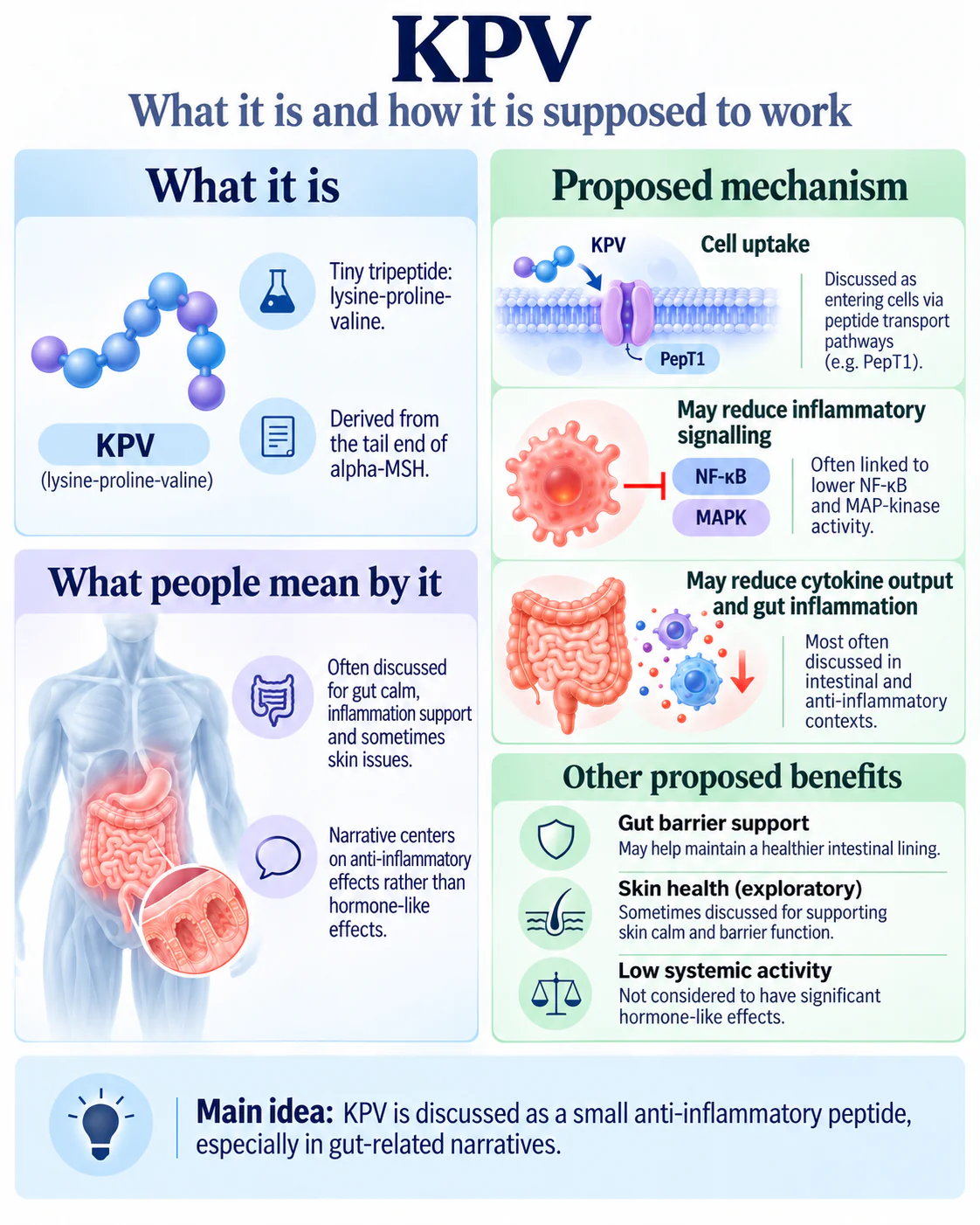
KPV is a short peptide fragment related to alpha-melanocyte-stimulating hormone. Laboratory findings and online claims about inflammation or gut health do not establish that a KPV product works in people. FDA says it has not identified human exposure data for drug products containing KPV and lacks important information about possible harm. This page does not provide dosing or sourcing advice.1
On this page
Why do people encounter KPV?
People researching gut inflammation may find KPV described alongside animal experiments; others encounter it in the KLOW blend, where some hope it may help with injection-site reactions. These are different questions. The gut study used cells and mice, not patients, and we found no controlled human comparison demonstrating that KPV reduces reactions to a peptide blend. See why KPV is added to some KLOW products and what a reaction can mean.
For the full story from gut experiments to the injection-site question, read KPV and inflammation explained.
For the proposed role of each ingredient and the evidence behind it, see how GLOW and KLOW are meant to work.25
Illustrations
Mechanisms and repair claims are hypotheses or early research, not established clinical benefits. Ingredients and products vary.
 Open image at full size
What the name describes
KPV is the three-amino-acid sequence lysine–proline–valine, discussed as a fragment related to alpha-MSH. A chemical identity does not tell us whether a marketed product has the claimed identity, purity, stability or route of administration. See storage claims, product quality and travel for practical context.1
What the evidence can and cannot show
Cell and animal studies can suggest biological questions, including effects on inflammatory pathways. They cannot establish a meaningful benefit in people, a safe human exposure or the performance of an online or compounded formulation. No standardised KPV product or controlled clinical outcome is established by the sources used for this profile.1
What did a gut-inflammation experiment actually study?
A 2008 study exposed human intestinal cell lines and immune cells grown in the laboratory to KPV and examined inflammatory signals. The researchers also studied two chemically induced models of colon inflammation in mice, adding KPV to their drinking water. They reported changes in inflammatory signalling in cells and reduced measures of inflammation in the mouse models. Human cells in a dish are not a clinical trial: the study did not show that a product treats inflammatory bowel disease in people, identify a safe human use or establish how an online formulation behaves.2
Does skin research prove a topical product works?
In its July 2026 advisory presentation, FDA described a laboratory study using human cadaver skin that found KPV did not permeate well. That observation concerns tissue studied outside a living person and may not predict every formulation. It does not establish whether a cream heals wounds, treats inflammation or is safe in people. The FDA reported that it had not identified human clinical studies supporting the nominated wound-healing and inflammatory uses.3
What the regulator record says
FDA states that it has not identified human exposure data for drug products containing KPV administered by any route and lacks important information about whether it could cause harm. That is an evidence and safety gap, not a finding that KPV is effective or ineffective.1
How to read a claim
Ask whether the exact chemical form and route were studied in humans, whether the study had a meaningful comparison, and whether identity, potency, sterility and impurities were independently assessed. A mechanism, testimonial or certificate of analysis cannot answer all of those questions.1
U.S. compounding policy: a narrow interim position
In October 2026 HHS published a draft interim enforcement-discretion policy covering specified forms of BPC-157, TB-500, KPV, epitalon, MOTS-c and Semax in section 503A compounding. Its Appendix B identifies the chemical form and routes addressed for each peptide; the policy also describes conditions including a patient-specific prescription, ingredient characterization and a single active ingredient. It is a statement of enforcement intent, not FDA approval or proof of safety or effectiveness; it does not establish the legality or quality of an online vial or a multi-ingredient stack. Read the peptide overview and the linked HHS policy for the specific conditions. Checked 5 November 2026. For the conditions and the separate 2027 advisory discussion, see the US policy guide.4
Further reading
Trusted external resources selected to help explain this page. They open in a new tab.
- Certain bulk drug substances that may present significant safety risks ↗Read the original regulator safety record for context and details.
- PepT1-mediated tripeptide KPV uptake reduces intestinal inflammation ↗An experimental model, not a trial of inflammatory bowel disease treatment in people.
- FDA advisory presentation on KPV (2026) ↗The KPV portion discusses proposed topical uses and data identified at the time of review.
Sources, kept close.
Selected supporting sources; this is not a complete literature review.
- Certain bulk drug substances that may present significant safety risksU.S. Food and Drug Administration · Regulator safety record
- PepT1-mediated tripeptide KPV uptake reduces intestinal inflammationGastroenterology / PubMed · Primary preclinical study of human cell lines and mouse models; 2008
- Pharmacy Compounding Advisory Committee: KPV presentationU.S. Food and Drug Administration · Regulator advisory presentation; United States; July 2026
- HHS Enforcement Discretion Policy Regarding 503A Compounding Using Certain Peptide Bulk Drug SubstancesU.S. Department of Health and Human Services · Policy PDF; Appendix A/B conditions and scope
- Discussion of GLOW reactions and KLOW (unverified individual comments)Reddit, r/BiohackingU · Anecdotal discussion; not clinical evidence